



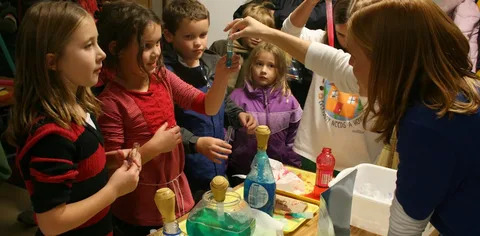
 STEM education is an interdisciplinary approach that blends Science, Technology, Engineering, and Mathematics into a unified learning experience. In early childhood education, STEM is not taught as separate academic subjects. Instead, it is introduced through exploration, inquiry, and play-based discovery that aligns with how young children naturally learn.
STEM Learning Designed for Young Minds
In early learning environments, STEM learning focuses on:
- Observing how things work
- Exploring cause-and-effect relationships
- Making predictions and testing ideas
- Learning through trial and error
For example, when children experiment with water flow, they are engaging in scientific inquiry. When they build towers with blocks, they are practicing engineering and problem-solving. When they count objects or compare sizes, they develop early math skills. These experiences collectively support early STEM skill development. A Developmentally Appropriate STEM Curriculum
A strong STEM curriculum for young children is flexible and responsive. It emphasizes curiosity rather than correctness and encourages children to think independently. At this stage, learning outcomes are measured not by right answers but by engagement, persistence, and problem-solving efforts.
Why STEM Is Important in Early Childhood Development
Understanding why STEM is important in early childhood begins with recognizing how quickly young brains develop. The early years are a critical window for building neural connections related to reasoning, logic, language, and emotional regulation.
Cognitive, Social, and Emotional Benefits of STEM Education
STEM education supports whole-child development by strengthening:
- Critical and analytical thinking
- Creativity and innovation
- Emotional resilience through problem-solving
- Collaboration and communication skills
When children encounter challenges during STEM activities, they learn perseverance. They discover that mistakes are part of learning, which builds confidence and a growth mindset.
Long-Term Academic and Life Readiness
Early exposure to science and math learning for preschoolers builds a strong academic foundation while reducing future learning anxiety. Children who experience STEM early often approach new concepts with confidence and curiosity rather than hesitation.
How STEM Learning Builds Real-World Skills Early
STEM education is closely connected to real-life learning. It teaches children how to think, how to analyze, and how to adapt—skills that extend far beyond the classroom.
Developing Problem-Solving and Critical Thinking Skills
Through preschool STEM learning activities, children learn to:
- Identify problems
- Explore multiple solutions
- Test ideas and refine approaches
- Draw simple conclusions
These skills translate directly into everyday decision-making and future academic success.
Building Early Engineering and Technology Awareness
Age-appropriate engineering challenges introduce children to concepts like balance, structure, and design. Simple technology exposure helps children understand tools as learning aids rather than passive entertainment.
Play-Based STEM Learning at Willow Bend Learning Center
At Willow Bend Learning Center, STEM education is delivered through play-based STEM learning, ensuring that learning remains joyful, engaging, and developmentally appropriate.
STEM Integrated Into Everyday Experiences
Rather than isolating STEM into a single lesson, Willow Bend embeds STEM learning into:
- Daily routines
- Group activities
- Free-play exploration
- Guided discovery sessions
This integration allows children to see learning as part of everyday life, not a separate task.
Intentional Teaching Through Guided Discovery
Educators at Willow Bend act as facilitators, asking open-ended questions, encouraging exploration, and guiding reflection. This approach ensures that children remain active participants in their learning journey.
STEM Activities and Curriculum at Willow Bend
The STEM curriculum at Willow Bend Learning Center is carefully designed to align with early childhood development milestones while allowing flexibility for individual learning styles.
Examples of STEM Activities Used at Willow Bend
STEM activities include:
- Hands-on science experiments using everyday materials
- Math-based games focused on counting, patterns, and measurement
- Engineering challenges with blocks and creative materials
- Nature-based exploration and observation
- Age-appropriate technology interactions
These activities support early STEM skill development while nurturing creativity and independence.
Personalized Learning and Observation
Educators observe each child’s interests and progress, adjusting activities to meet individual needs. This personalized approach ensures that every child benefits from STEM learning at their own pace.
How Parents Can Support STEM Learning at Home
STEM education is most effective when learning continues beyond the classroom. Parents play a crucial role in reinforcing STEM concepts through everyday interactions.
Everyday STEM Opportunities for Families
Parents can support STEM learning by:
- Cooking together and discussing measurements
- Building with blocks or recycled materials
- Exploring nature and asking “why” questions
- Playing sorting, matching, and counting games
A Strong Home–School Partnership
Willow Bend Learning Center encourages collaboration with families, ensuring children receive consistent support both at school and at home.
Conclusion
STEM education empowers children to explore, question, and solve problems with confidence. At Willow Bend Learning Center, STEM education is thoughtfully woven into everyday learning experiences through play-based methods and a developmentally appropriate curriculum.
By prioritizing STEM education, STEM activities, and meaningful STEM learning, Willow Bend prepares children not only for academic success but for a lifetime of curiosity, adaptability, and growth.
FAQs About STEM Education
What age should children begin STEM education?
STEM learning can begin in toddlerhood through exploration-based, play-driven activities.
Why is STEM important in early childhood education?
STEM builds critical thinking, problem-solving, and foundational science and math skills during key developmental years.
How does Willow Bend incorporate STEM daily?
STEM is integrated into routines, guided play, and hands-on exploration rather than isolated lessons.


